Incoming customer PO
Your customer orders items from you. The question is how to extract order lines, map SKUs and prepare a usable order handoff.
Follow the intake workflow
 BY NUMBER7 AIOpen AIdaptIQ ↗Book a demo →
Incoming customer purchase orders
Turn incoming customer POs into structured order information. Evaluate variable layouts, line completeness, SKU mapping and the review needed before your order-system handoff.
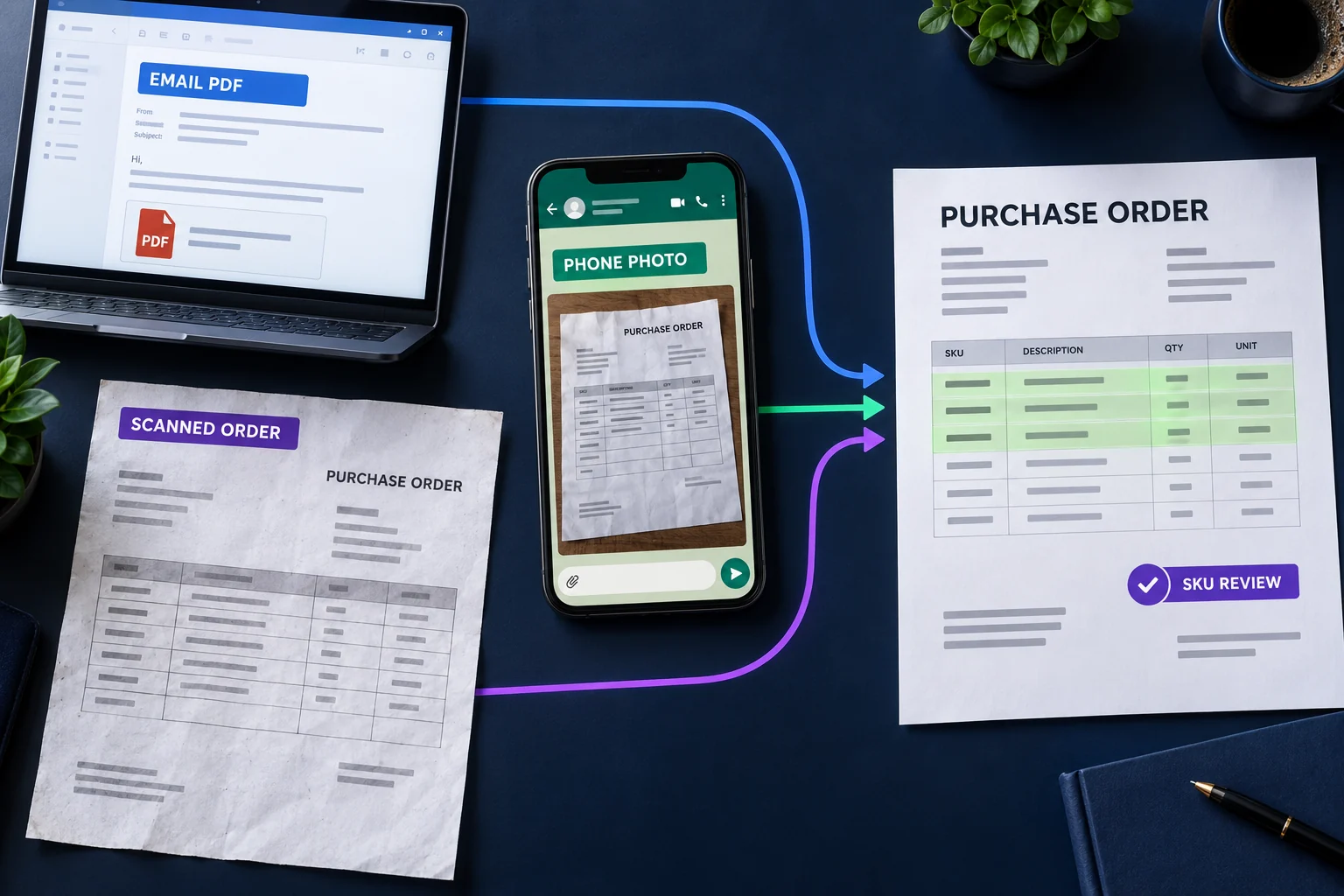
Customer orders to reviewable lines
Evaluate the PDFs, scans and image-based orders that arrive through your actual channels.
Keep the original source available while checking complete order lines, quantities and customer details.
Use the relevant customer and item context. Route uncertain matches to review instead of accepting a plausible item.
Define the accepted output and downstream order-system integration. Do not assume extraction alone created a sales order.
Directly relevant evidence
JSK’s case describes email PDFs, scans and WhatsApp-originated images becoming structured order lines, SKU mapping and review. The reported 10× intake improvement belongs to that customer workflow; it is not a general speed guarantee or proof of supplier three-way matching.
Read the reported result and scope · Customer evidence ledgerTwo different purchase-order questions
Your customer orders items from you. The question is how to extract order lines, map SKUs and prepare a usable order handoff.
Follow the intake workflowYour organization buys from a supplier. The question is whether the invoice is supported by the ordered and cumulatively received quantities.
Explore supplier three-way matchingPurchase-order data entry questions
Incoming customer PO data entry prepares order information and SKU mapping. Supplier three-way matching reconciles your PO, receiving evidence and supplier invoice. They have separate inputs and acceptance criteria.
A structured PO result is not itself a sales order. Confirm the order-system integration, required fields, authorization and returned record before measuring order creation as completed.
Freeze the customer and SKU catalog, retain the source description, measure line completeness and record every manual choice. A missing or ambiguous mapping belongs in review.
Scope and action
The JSK case documents customer-PO intake, structured order lines and SKU mapping. Agree the downstream order-system handoff separately.
Action: Automatic with review.
Read the workflow scopeThe recorded product-owner confirmation applies to the named capabilities. Deployment scope, integration permissions and approval requirements are agreed separately.