
 BY NUMBER7 AI

Industrial distribution · Purchase orders
Turn incoming purchase orders into work the team can use.
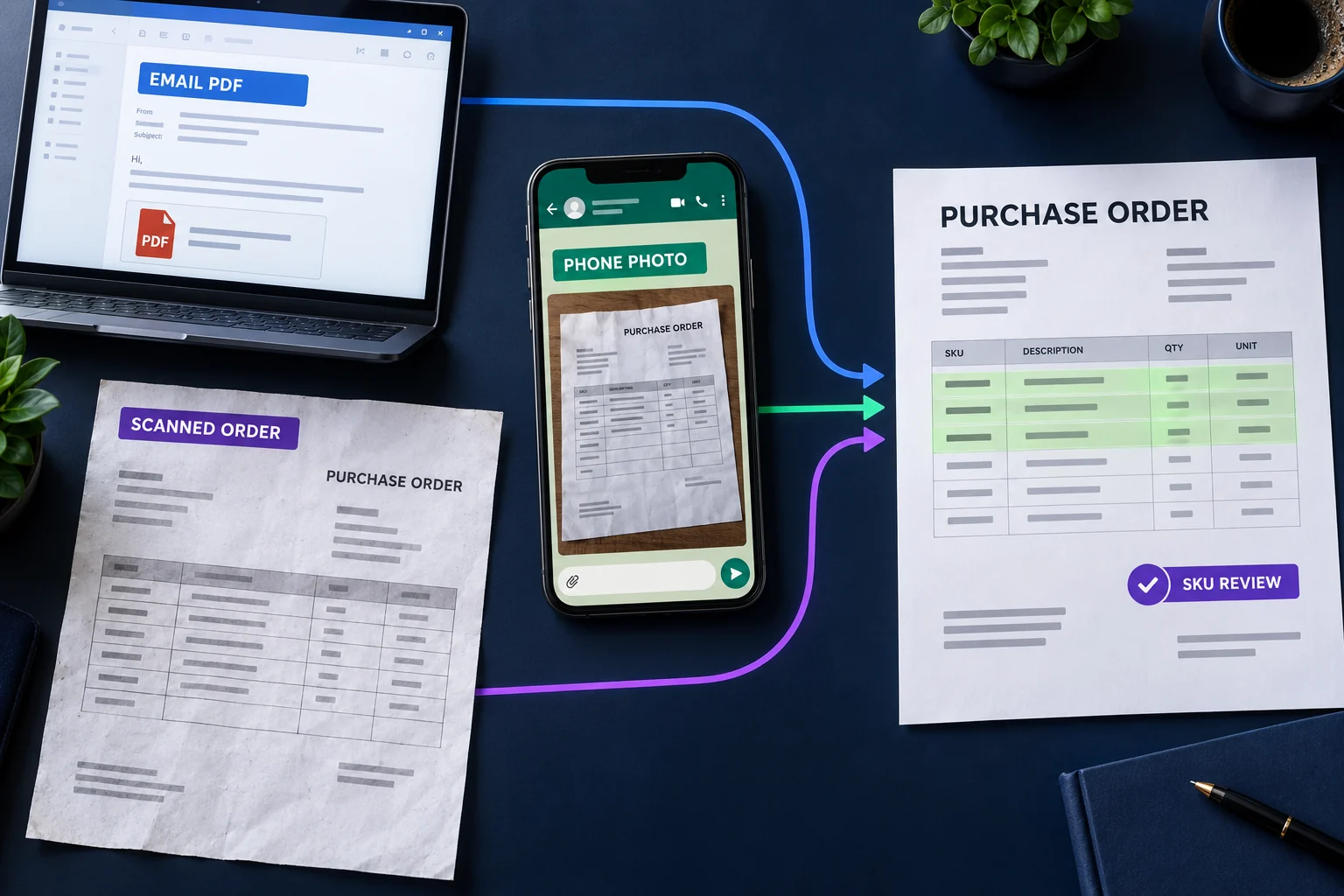
JSK combined purchase orders from email PDFs, scans and WhatsApp-originated images into extraction, SKU mapping and review. The published case reports 10× faster intake; accuracy figures relate to pilot field validation.
Three input channels
- Email PDF
- Scanned order
- Phone image
Structured order linesKnown SKU · or named mapping review
- Purchase-order intake
- 10×
- Pilot field validation
- 98.7%
Reported faster intake in the described workflow.
Reported pilot field accuracy; not end-to-end order completion.
01 / The operation
The work that constrained the team.
Customers send purchase orders in the format they choose. Before the commercial team can act, PDFs, scans and photographs need usable order information and product references. Manual retyping and repeated interpretation of descriptions and SKUs delayed that handoff.
No specific pre-existing ERP or document platform is named in the available evidence. WhatsApp-originated documents describe an input source, not a particular direct API integration.
02 / What changed
Make the order usable, not just readable.
Header and line extraction reduce retyping. SKU mapping connects descriptions to product references. Ambiguous values remain visible for review before the order information is handed over.
Scroll across to compare the columns
| Work | Before | With AIdaptIQ |
|---|---|---|
| Arrival | Separate formats and entry habits | One intake and extraction path |
| Order entry | Manual retyping of fields and lines | Structured header and line capture |
| Products | Interpret descriptions and find item references | SKU mapping with review |
| Commercial response | Wait for document preparation | Act on reviewed order information |
A description matches more than one item.
Source: an ambiguous product description. Check: multiple catalog candidates. Next action: retain the source line and ask the operator to select the correct SKU before handoff.
This example explains the review mechanism; it is not a recorded JSK order.
The workflow and retained review
Unclear descriptions, uncertain product mappings and commercial decisions remain with the appropriate person. A processed purchase order does not itself authorize inventory allocation or acceptance of customer terms.
Document information, configured checks, human review and the final downstream outcome remain distinct. This case does not claim that every internal Number7 architecture module was deployed.
03 / Reported result
Intake speed and field accuracy answer different questions.
The reported change
The published case reports 10× faster intake and 98.7% field accuracy in pilot validation. It also gives complex-PO handling ranges of 20–40 minutes before and 2–5 minutes for exception handling afterward.
Evidence basis: Number7 AI’s published customer account and retained case material. These results are not independently audited or universal guarantees. Read the customer evidence ledger · How to evaluate these results
Economics and interpretation
Less preparation can release time for commercial work. No staffing reduction, realized revenue uplift or payback measurement is supplied for this case. Released capacity does not automatically become booked revenue.
Evaluation model — not a realized resultMonthly PO volume × measured active minutes saved per PO ÷ 60. Value the hours at the actual operating cost, then deduct review, platform and transition costs.
04 / Your operation
How much work sits between your inbox and a usable order?
Include PDFs, scans, photographs and difficult descriptions. Score header extraction, complete lines, SKU mapping and reviewer effort separately. Define the final accepted output before comparing time.
Evaluate the same kind of work