
 BY NUMBER7 AI
FOR ACCOUNTING BPO OPERATIONS
Protect delivery margin as transaction volume grows.
AIdaptIQ reduces the operational work between incoming documents and controlled accounting outcomes while preserving client-specific rules, evidence and service ownership.
Follow the work behind the SOW.
FOLLOW THE WORK BEHIND THE SOW
INTAKEClient + service scope
ROUTINERequired checks pass
EXCEPTIONSOwner + client dependency
MEASURETouches + SLA + accepted outcomes
One delivery queue, separate client scope
Document population enters the agreed service boundary.
Inspect stage records
INTAKEClient + document familyIdentify
CONTRACTService scope and SLARetain
DELIVERYNamed process ownerAssign
Routine checks run in the workflow
Processing effort and exception effort remain separate.
Inspect stage records
EVIDENCEDocument and accounting contextCheck
ROUTINERequired checks satisfiedProceed
EXCEPTIONMissing receipt or conflicting valueHold
Route the smallest complete question
The live clarification path reduces repeated investigation across operators, reviewers and clients.
Inspect stage records
OWNERExact exception + sourceAssign
REPLYFull prior thread + new evidenceLink
CONTROLRe-evaluate before handoffReplay
Measure the human work that remains
Retained benefit depends on the workflow boundary and commercial model.
Inspect stage records
TOUCHESRoutine + exception + QAMeasure
SLAActive work versus client waitSeparate
OUTCOMEAccepted result + reworkTrack
Select a stage to pause and inspect the detail.
Inspect delivery economics
Contract revenue100
Processing labour-36
Exception labour-18
Supervision & QA-12
Software & operations-9
Retained margin25
FINANCE BPO · DELIVERY ECONOMICS
Measure the work removed from the SOW—not only document accuracy.
More profitable delivery capacity requires routine throughput, exception effort and client dependencies to be measured separately against quality and retained margin.
MULTI-CLIENT INTAKEFiles · email · combined PDFsClient, entity and service scope stay attached.
MEASURE THE REMAINDERTouch rateOperator minutesReworkResolution timeSLA agingAccepted outcomes
Workflow closure required
- Bulk, multi-client intakeSplit and route documents without merging client truth.
- Client accounting contextRetain vendor, GL, dimensions, policy and precedent by client.
- Role-based exception operationsSend the smallest complete question to the correct delivery role.
- Transaction-bound client questionsAsk from the bill and retain the complete previous conversation.AVAILABLE NOW
- Accounting-system handoffReturn the accepted record ID or an owned failure.DEPLOYMENT-DEPENDENT
- Production measurementTrack throughput, human touches, rework and resolution against the SOW.SCOPED PER WORKFLOW
What the business case must measure
- Straight-through rateUse one frozen entry and exit definition.
- Active laborSeparate handling time from client waiting time.
- Quality and reworkCount reversals, reopened work and manual rescue.
- Commercial captureModel who retains the gain under FTE, transaction or fixed-fee pricing.
Bulk intake, validation, role queues and accounting output.
Add touch, STP, rework and cost-per-outcome measurement.
Add clarification, approval, control tower and payment-state responsibility.
Manage SLA, quality, capacity and retained economics as one operating system.
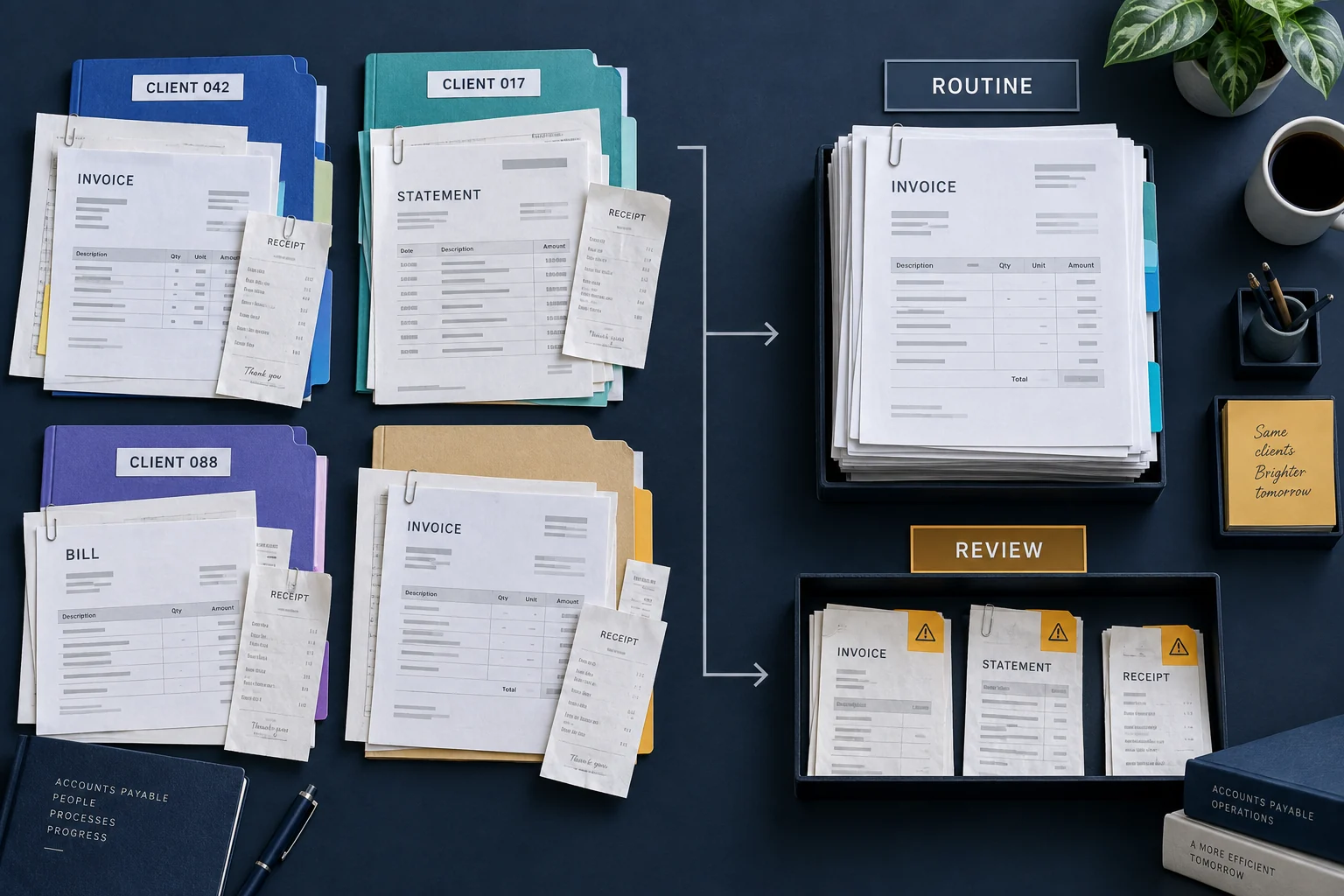
THE MULTI-CLIENT OPERATING MODEL
Scale the completed work. Isolate the judgment.
Client boundaries remain visible while routine documents move forward and the smaller exception population reaches the right reviewer.
DIRECT ANSWER
How does AP automation change BPO delivery economics?
It reduces unit delivery effort across processing, exceptions, supervision and coordination; how much value the provider retains depends on the commercial model and contract.
INSIDE THE WORKFLOW
The operating model, made visible.
See what needs attention, who owns the decision and what must happen next.
01 · ARRIVE
One intake queue
Invoices · purchase orders · receipts
INV-2048 Invoice
PO-1086 Purchase order
GRN-4102 Goods receipt
02 · CONNECT
Resolve the context
- Identify the entity
- Connect vendor and references
- Retain the source evidence
03 · ROUTE
12 assembled
Entity resolved
Continue to checks
2 need context
Route to review
Keep the original files attached
- 01Shared workflow population
- 02Processing and completion state
- 03Entity-level actions
DELIVERY CAPACITY
The work behind the unit cost.
Routine verification, exception triage, client clarification, rework, senior review, coordination and handoff reconciliation all consume delivery capacity.
Processing
Prepare and validate routine transactions.
Exceptions
Investigate evidence gaps and client dependencies.
Supervision
Sample, recheck and manage quality.
Coordination
Move work across people, clients and systems.
COMMERCIAL MODEL
Who retains the productivity benefit?
Efficiency value changes under FTE, transaction, fixed-price, cost-plus and outcome-based contracts.
FTE / resourceDepends on utilisation and repricing.
TransactionProvider can retain unit-cost improvement.
Fixed priceProvider generally retains efficiency.
Cost plusBenefit may pass through to the client.
Outcome / gainshareValue is contractually shared.
CLIENT-SPECIFIC CONTROL
Standardise the operation without flattening client rules.
One delivery layer can preserve separate accounting context, evidence, approvals and SLAs.
EVIDENCEEmail · Upload · API
AIdaptIQState · Controls · Resolution
SYSTEM OF RECORDQuickBooks · Tally · ERP
PRODUCTION BOUNDARY
Evidence with scope.
One reported production workflow processed 50K+ documents per month across 300+ entities and moved from 12 to 3 reported AP operators.
Review one delivery process.
Freeze the volume, exception mix, labour steps and commercial boundary.