
 BY NUMBER7 AI
FOR ACCOUNTING FIRMS & CAS TEAMS
Review more client books without checking every invoice.
AIdaptIQ handles document intake, transaction checks, client questions and QuickBooks handoff so reviewers can focus on accounting judgment rather than routine verification.
Three client books. One reviewer’s attention.
CLIENT CONTEXT NEVER MERGES
CLIENT 042Coding precedent
CLIENT 017Ask client from bill
CLIENT 088Routine batch ready
One reviewerQuestion + source + prior history + recorded outcome
Client evidence arrives
Shared intake preserves the client boundary on every document.
Inspect stage records
CLIENT 042Invoice + source PDFReceived
CLIENT 017Approval evidence missingHold
CLIENT 088Routine invoice batchReceived
Apply each client’s accounting context
Shared processing never merges vendor, GL or dimensional treatment.
Inspect stage records
CLIENT 042Location + class precedentCheck
CLIENT 017Own approval authorityRequired
CLIENT 088Own QuickBooks destinationLinked
Ask from the transaction
The live workflow sends the precise client question with the invoice and keeps the previous conversation visible.
Inspect stage records
QUESTIONApproval evidence for INV-2048Sent
HISTORYEarlier comments and repliesRetained
ROUTINEOther client workProceed
Bind the reply and record the outcome
The response returns to the bill; affected controls replay before the accounting handoff.
Inspect stage records
REPLYLinked to INV-2048Evidence
CONTROLApproval evidence re-evaluatedReplay
QBOReturned result or owned failureRetain
Select a stage to pause and inspect the detail.
ACCOUNTING & CAS · MULTI-CLIENT DELIVERY
More client books per team—not one generic AP queue.
AIdaptIQ preserves each client’s accounting context while routine invoices proceed and only the unresolved accounting question reaches the reviewer.
REVIEWER ATTENTIONOne accounting questionSource · prior treatment · material consequence · next action
LIVE IN AIdaptIQ
Question from INV-2048 Please confirm the missing approval evidence.
Previous history retained Earlier comments and replies remain beside the bill.
Reply linked → controls replayWorkflow closure required
- Portfolio and client isolationRoute every document, rule and action to the correct client book.
- Client-specific accounting contextVendor, GL, location, class, department and project treatment stay scoped.
- Exception-first reviewRoutine work recedes; changed precedent and material risk reach reviewers.
- Client clarificationAsk from the invoice, retain the complete previous history and bind the reply.AVAILABLE NOW
- QuickBooks handoffRetain the reviewed transaction, returned identifier and owned failure.DEPLOYMENT-DEPENDENT
- Portfolio readinessExpose client response, approval and material blockers to partners and controllers.
The reviewer should receive
- The questionWhat changed or remains unsupported.
- The sourceInvoice, evidence locator and affected accounting field.
- The precedentThe client-specific prior treatment and applicable rule.
- The next actionDecide, ask the client, approve or hold.
Capture, code, review and post across multiple client books.
Add client rules, dimensions, recurring exceptions and clarification.
Prioritize materiality, approvals, client dependencies and close blockers.
Best first scope: three contrasting client books—one routine, one exception-heavy and one growing—measured on touches and reviewer demand.
THE REVIEWER’S DAY
Open the question, not every document.
One queue carries the decision, the relevant source and the client boundary. Routine items remain out of the reviewer’s way.
DIRECT ANSWER
How does AP automation increase reviewer capacity for accounting firms?
It removes routine verification, document chasing and handoff work across client books while preserving client-specific evidence, accounting context and review authority.
INSIDE THE WORKFLOW
The operating model, made visible.
See what needs attention, who owns the decision and what must happen next.
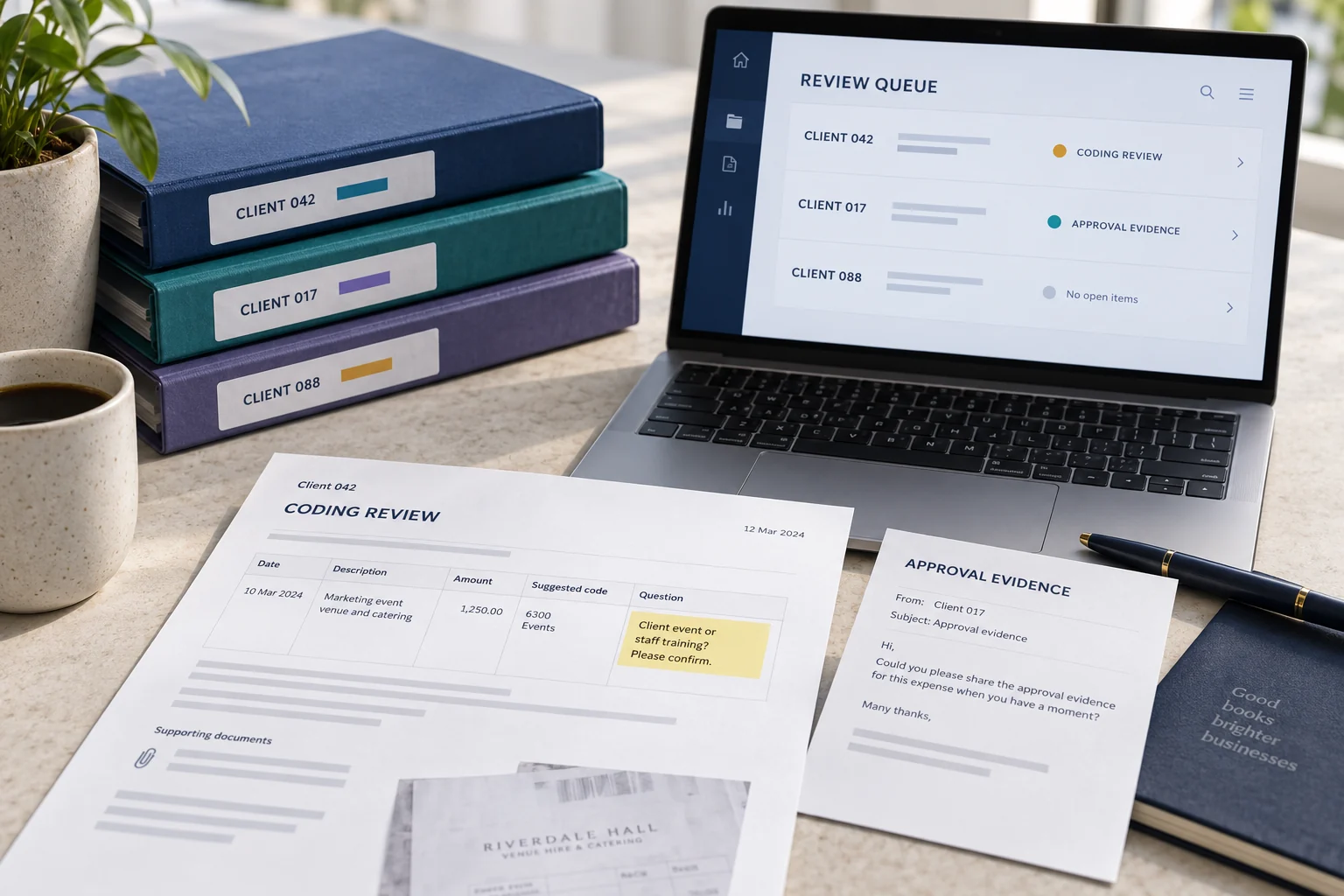
ILLUSTRATIVE REVIEWER QUEUEShared team. Separate client context.
CLIENT 042Coding precedent changedJudgment
CLIENT 017Missing approval evidenceClient input
CLIENT 088Routine batch completedReady
Review the next item with its own client, evidence and accounting context intact.
- 01Client and company context
- 02Invoice detail and source
- 03Accounting fields and totals
THE CURRENT BOTTLENECK
Give reviewers the accounting question, not another document queue.
Client inbox → document tool → spreadsheet → reviewer → QuickBooks → follow-up email.
Collect
Find the client document and context.
Verify
Recheck extracted values and accounting treatment.
Clarify
Ask the client for missing evidence.
Record
Create and reconcile the QuickBooks outcome.
MULTI-CLIENT OPERATION
Shared workflow. Separate client truth.
Vendor context, accounting mappings, evidence and authority remain isolated by client.
Shared operating path
Standardise intake, controls and exception handling.
Client-specific context
Preserve vendor, account, tax and approval differences.
Portfolio review
Give senior reviewers only the decisions that require judgment.
THE HUMAN REMAINDER
Extraction is only the beginning.
Measure document chasing, coding uncertainty, exception investigation, client clarification, reviewer rechecking and failed handoffs.
Capacity compounds when senior attention follows material exceptions instead of every invoice.
Operating thesis
PRODUCTION BOUNDARY
Evidence with scope.
One reported production workflow processed 50K+ documents per month across 300+ entities and moved from 12 to 3 reported AP operators.
Map three client workflows.
See where reviewer capacity is consumed and which work can move safely.