
 BY NUMBER7 AI
Preserve page boundaries and route ambiguous separators to review.
HIGH-VARIANCE DOCUMENT OPERATIONS
Process the invoices your current automation sends to manual review.
Mixed layouts, multiple invoices, irregular tables, poor scans and missing context reveal whether a system can produce a controlled transaction or merely extract text.
A difficult file still needs a clear outcome.
MIXED DOCUMENTS → EXPLICIT OUTCOMES
Multi-invoice PDFScan / photoIrregular table
Assemble pages + retain source references
Validate identity, quantities and context
ProceedRequest evidenceReview
Start with the actual document mix
Layouts, scans and multi-invoice PDFs enter reviewable intake.
Inspect stage records
PDFMultiple invoice boundariesInspect
SCANImage and handwriting qualityInspect
LINESIrregular or multi-page tableInspect
Assemble the document evidence
Preserve source pages across splitting and normalization.
Inspect stage records
BOUNDARYSeparate invoice familiesResolve
SOURCEKeep original page referencesRetain
TABLENormalize supported line valuesStructure
Check claims against context
Readable text alone does not establish a safe transaction.
Inspect stage records
MATHQuantity, price and totalsCheck
IDENTITYVendor and entityCheck
PURCHASERequired PO and receiptCheck
Three explicit outcomes
Uncertainty remains visible with the next action.
Inspect stage records
SUPPORTEDRequired evidence establishedProceed
MISSINGExact document or context gapRequest
AMBIGUOUSSource + material judgmentReview
Select a stage to pause and inspect the detail.
THREE DIFFICULT INPUTS
Show the problem, the structured result and the review condition.
The document may change shape; the accounting obligation does not.
Retain source rows and flag unresolved column meaning.
Route unreadable or materially ambiguous evidence instead of silently filling it.
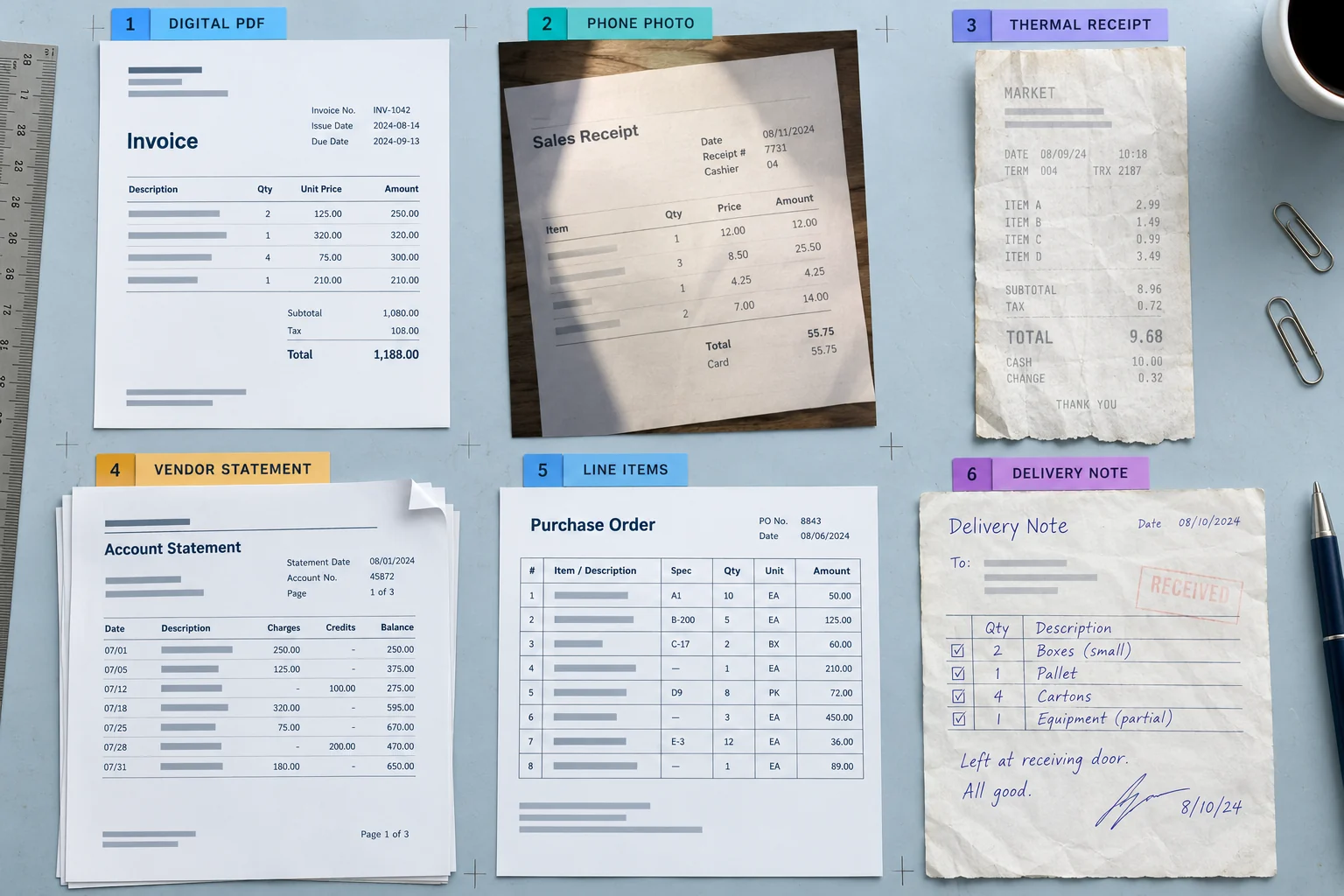
THE REAL DOCUMENT POPULATION
Different shapes. One controlled obligation.
Evaluation should include the PDFs, photographs, tables, statements and handwritten evidence that create the real human workload.
DIRECT ANSWER
How should difficult invoices be automated?
Extract what the source supports, preserve the evidence, abstain where a material claim is uncertain and route the exact gap into a controlled resolution path.
WHERE VARIANCE APPEARS
The document changes shape; the accounting obligation remains.
Layout variance
The same field appears in different positions and labels.
Table variance
Line items span pages, merge cells or use vendor-specific columns.
Document mixtures
Several invoices or supporting documents share one file.
Image quality
Scans, handwriting and compression reduce readable evidence.
Missing context
A document may omit the PO, receipt or entity reference.
Conflicting evidence
Documents can disagree even when extraction is accurate.
SAFE AUTOMATION HAS THREE OUTCOMES
Not every document should take the same path.
Safely structured
Required claims are supported and controls can proceed.
Needs evidence
The exact missing document or context is named.
Needs judgment
The source and decision arrive together for review.
SOURCE BESIDE THE CLAIM
The reviewer should not reconstruct the document from extracted JSON.
A focused product view keeps line items and their source visible together.
PO-1086
500 orderedQuantity committed
GRN-4102
300 receivedQuantity supported
INV-2048
500 invoiced500 units × ₹840
SOURCE EXCERPT · INVOICE PAGE 2, LINE 4
PO referencePO-1086
Quantity × unit price500 × ₹840
Line amount₹4,20,000
MATCH RESULT200 units unsupported
300 received + 200 still need evidence
Hold → ask the warehouse owner for the remaining receipt → re-check.
- 01Original document
- 02Normalized line items
- 03Validation and review state
THE 50-DOCUMENT TORTURE TEST
Use a representative population, not the cleanest demo invoice.
Include multiple vendors, interleaved invoices, multiple currencies, inconsistent tables, handwriting, scans and missing supporting evidence.
A difficult population reveals the human remainder that average field accuracy hides.
AIdaptIQ evaluation principle
Bring the documents your current stack avoids.
We will separate safe automation, missing evidence and required judgment.