WHY AP REVIEW SCREENS ARE ACTUALLY FOUR BOTTLENECKS WEARING ONE BADGE
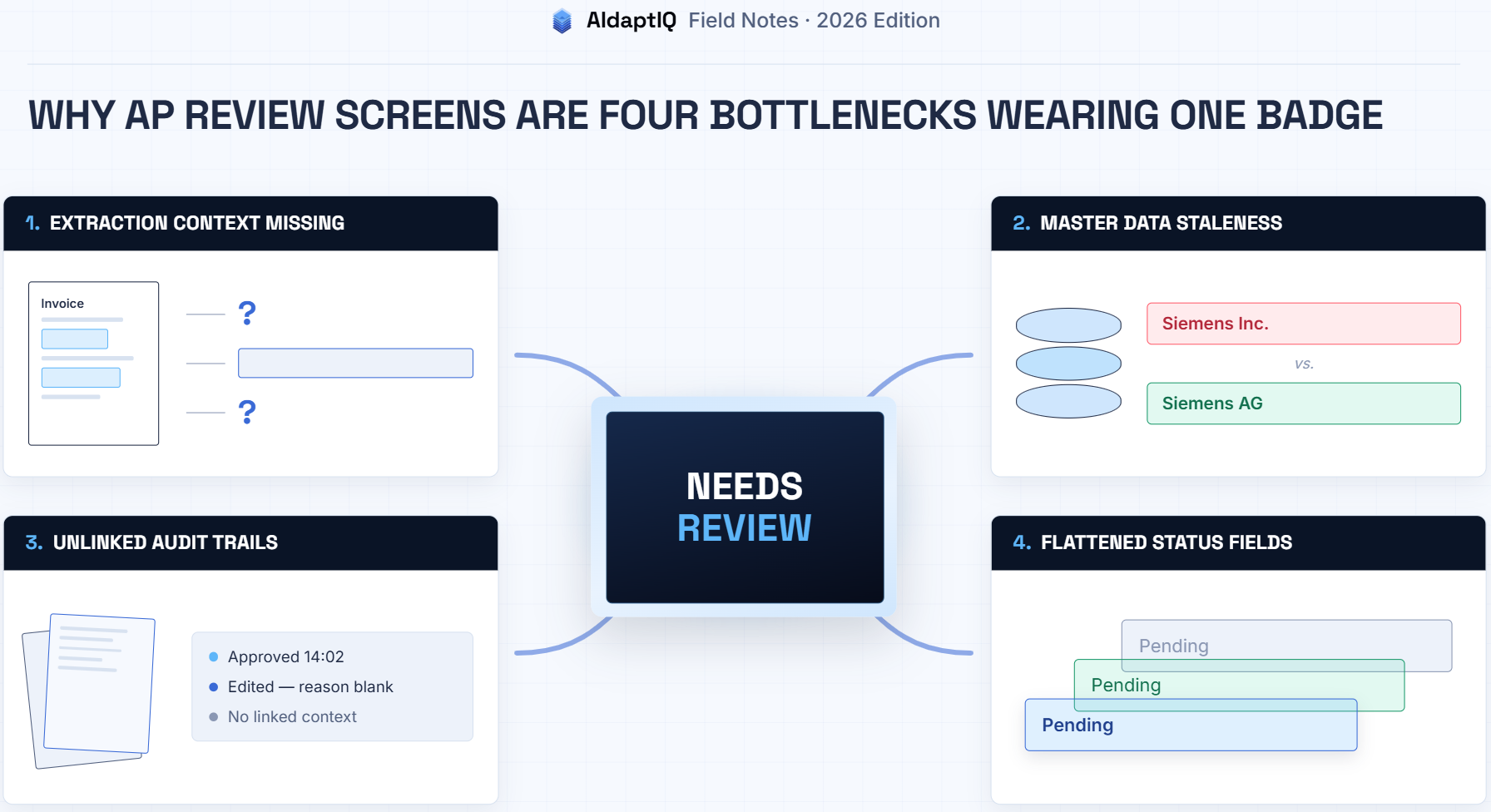
What "Needs Review" Is Actually Hiding — Extraction vs. Matching, Stale Master Data, Fragmented Audit Trails, and Flattened Status AIdaptIQ Field Notes · 2026 Edition
⚠ Most AP Teams Treat "Review" as One Step. It's Actually Four Separate Problems Stacked Into One Badge. Ardent Partners puts average invoice processing cost at $9.40–$16.48 depending on methodology, with Best-in-Class teams at $2.78–$5. The gap isn't extraction anymore — every serious platform reads a vendor name and a total correctly now. The gap is what happens after extraction, when a human has to decide what a flagged invoice actually needs. Industry data shows 22% of invoices hit some kind of exception, and the average exception takes 5 to 8 days to resolve — not because the problem is hard, but because most tools give the reviewer no information about why it's flagged, whether the master data is even right, who decided what last time, or how urgent this particular flag actually is relative to the other 40 sitting in the same queue. This document breaks down the four distinct problems most AP platforms have quietly merged into a single review step, with the data on what each one actually costs left unsolved.
The Full Bottleneck Map: Four Problems Wearing One Badge
Every AP platform we've evaluated has a "needs review" state. Almost none of them separate what actually landed an invoice there. The four problems below get flattened into that one flag constantly, and each one has a different fix.
| Bottleneck | Visibility | Typical Cost / Impact |
|---|---|---|
| Extraction correct, matching context missing | Hidden until reviewed | 5–8 days average exception resolution; 1–2 days for top-performing teams |
| Master data treated as read-only truth | Hidden (compounds silently) | Vendor spend split across duplicate records; discount thresholds missed |
| Audit trail as log, not context | Visible only under audit | $7.8M average cost to remediate one SOX material weakness |
| Status collapsed to a single field | Visible but uninformative | 29% of enterprises need 6+ approvals, extending cycles past 3 weeks |
Sources: Ardent Partners State of ePayables; Ken from Finance 2026 benchmarks; Zuora/Glossary Hub material weakness data; DocuClipper 2026
Bottleneck 1: Extraction Is Solved. Matching Context Isn't.
Pulling a vendor name, an invoice number, and a total off a PDF is table stakes in 2026. What almost no platform does well is explain why something doesn't reconcile against what the system already knows — a due date that's two days off the vendor's usual terms, a tax rate that looks wrong for the state on the invoice, a total that's technically correct but inconsistent with the vendor's historical pattern.
Exceptions Are Now AP's Single Biggest Challenge — For the First Time in 19 Years of Ardent Partners Research Factura.ai's analysis of Ardent Partners' 19-year running State of ePayables research found that invoice exceptions became AP's top-ranked challenge for the first time on record in the most recent survey cycle. The industry-wide exception rate sits around 22%, meaning roughly one in five invoices hits a wall of some kind. Top-performing teams resolve these in 1 to 2 days. The average team takes 5 to 8 days, and disputed-amount exceptions specifically can stretch past 30 days. The gap between best-in-class and average isn't extraction accuracy anymore — it's whether the reviewer gets context or just a flag. (Source: Factura.ai / Ardent Partners, Ken from Finance 2026)
| Metric | Average Team | Best-in-Class |
|---|---|---|
| Invoice exception rate | ~22% | Lower, better-triaged |
| Exception resolution time | 5–8 days | 1–2 days |
| Share of total cycle time spent on approvals | 60%+ | Substantially lower |
| Manual tasks as share of AP practitioner time | 84% (IOFM) | Automated triage frees this time |
| 22% <br>of invoices hit an exception of some kind <br>Ken from Finance, 2026 | 5–8 days <br>average time to resolve a flagged exception <br>Ken from Finance, 2026 | 84% <br>of an AP practitioner's time still spent on manual tasks <br>IOFM, cited in Gennai 2026 |
|---|
A flagged field with no context forces the reviewer to redo the investigation from scratch every time. A flagged field with a stated reason — "due date differs from this vendor's last 6 invoices," "tax rate inconsistent with state on file" — turns a 5-to-8-day investigation into a decision that takes seconds. That's the entire gap between average and best-in-class, and it has nothing to do with OCR accuracy.
Bottleneck 2: Master Data Is Treated as Read-Only, Never as Something to Fix
Nearly every reconciliation flow assumes the ERP is ground truth and the invoice is what gets checked against it. That assumption fails constantly, because vendor master data degrades on its own, independent of anything AP does.
A Vendor Representing $1.2M in Spend Can Be Invisible as a Single Line in Your Own Reports Research on vendor master data deduplication documents a pattern that recurs across organizations of every size: the same vendor gets entered once by AP off the invoice header, once by procurement off the contract, and once by a department off the W-9 — three slightly different names, three separate records, one vendor. A supplier representing $1.2M in annual spend can appear as three records at $400K each, which means the top-vendor report is wrong, volume discount thresholds go unclaimed, and at year-end, the same payee can end up with duplicate or conflicting 1099 filings under different tax IDs. (Source: CloudSquid vendor master deduplication research, 2026)
| Cause of Duplicate Vendor Records | How It Happens | Downstream Cost |
|---|---|---|
| Multiple entry points, no shared ID | AP, procurement, and department each create separate records | Spend visibility fragments; negotiating leverage lost |
| No unique key enforcement | Free-text name fields accept "Siemens," "Siemens AG," "SIEMENS" as distinct | Nothing blocks duplicate creation at the point of entry |
| M&A or system migration | Two vendor masters merged without deduplication | Duplicate payments, tax ID conflicts, audit flags |
| ERP treated as one-directional truth | Invoice reconciled against stale record, never corrects it | Mismatch flagged forever, root cause never fixed |
Most reconciliation tools flag "vendor address on file doesn't match invoice" as a mismatch and stop there. Almost none ask whether the invoice might be the current, accurate version and the ERP record is the one that's stale. Vendor master data problems are described bluntly in the research as something no organization creates on purpose — they accumulate, one inconsistent entry at a time, until an ERP migration or an audit surfaces the mess, usually at real cost.
Bottleneck 3: Compliance Logs and Human Reasoning Live in Different Systems
SOX Section 404 requires that public companies establish and maintain documented internal controls over financial reporting, and AP sits squarely inside that scope. The audit log most platforms keep — timestamp, user, field changed, old value, new value — technically satisfies "documented," but it doesn't answer the question an auditor, or a controller six months later, actually asks: why was this override approved?
$7.8 Million: The Average Cost to Remediate a Single SOX Material Weakness Glossary Hub's compilation of material weakness remediation data puts the average cost to eliminate one material weakness at $7.8 million once external fees, leadership time, and process rebuilds are counted. Separately, IPO material weakness studies show 26–34% of NYSE- and NASDAQ-listed companies disclose at least one material weakness in their S-1 filings, and management-identified weaknesses have trended upward over time, from roughly 15% to 22% of filers, according to Houseblend's review of SOX Section 404 compliance data. (Sources: Zuora/Glossary Hub 2026; KPMG IPO Material Weakness Study; Houseblend SOX 404 Guide 2026)
| $7.8M <br>average cost to remediate one SOX material weakness <br>Glossary Hub, 2026 | 26–34% <br>of recent IPOs disclosed a material weakness in S-1 filings <br>KPMG IPO Material Weakness Study | 22% <br>of filers now self-identify weaknesses, up from ~15% <br>Houseblend SOX 404 Guide, 2026 |
|---|
A control that can't show its own reasoning isn't really documented, it's just logged. Merging edits, approvals, findings, and human commentary into a single chronological record attached to the document — rather than splitting them across a compliance panel and a separate comments thread — is closer to what "documented control" is actually supposed to mean.
Bottleneck 4: Status Is Multi-Dimensional, But Most Tools Force It Into One Field
An invoice can simultaneously be pending approval, flagged as a possible duplicate, and mismatched on tax rate. Most platforms give it exactly one status field to represent all three conditions at once, which means a 200-invoice queue tells a reviewer nothing about which ones are stuck for which reason.
29% of Enterprises Require Six or More Approval Steps — Stretching Cycles Past Three Weeks DocuClipper's 2026 compilation of AP statistics found that 29% of enterprises require six or more separate approvals to clear a single invoice, extending processing time to three weeks or more in those organizations. Separately, global average invoice approval time runs 8.5 days for manual workflows versus 1.2 days for automated ones — a gap that widens further once approval routing has to account for entity, department, and vendor-risk-level rules simultaneously. (Sources: DocuClipper 2026; WifiTalents 2026 AP statistics)
| Approval Complexity | Manual / Undifferentiated Status | Cycle Time Impact |
|---|---|---|
| 1–2 approval steps | Single "pending" flag sufficient | Minimal delay |
| 3–5 approval steps | Status ambiguity begins to compound | Multi-day delays common |
| 6+ approval steps | Undifferentiated status makes triage impossible without opening every invoice | 3+ weeks, per DocuClipper 2026 |
What Fixing All Four Actually Looks Like
None of these four problems are individually hard to name. They're hard to fix because most AP tools were built around the median invoice — one vendor, one clean total, one approver — and review was bolted on afterward to catch whatever didn't fit that shape. Patching the bolt-on doesn't help. Treating review as four distinct problems from the start, each with its own severity level, its own master-data correction path, its own place in a unified audit timeline, and its own status dimension, is what actually collapses the 5-to-8-day average down toward the 1-to-2-day best-in-class benchmark.
Frequently Asked Questions
Is this an extraction accuracy problem? No. Field-level extraction accuracy is largely solved across the serious platforms in this market. The unsolved problem is what happens to a correctly-extracted field once it doesn't match expectations — whether the reviewer gets context, whether the master data itself gets corrected, and whether the audit trail captures the reasoning behind the resolution.
Does better matching alone fix the exception backlog? Partially. Better matching logic reduces false-positive exceptions, but the 5-to-8-day average resolution time is driven as much by reviewers having to reconstruct context from scratch as by the volume of exceptions itself. Severity tiering and stated reasons for a flag close more of that gap than matching accuracy alone.
Why does vendor master data drift if the ERP is supposed to be the source of truth? Because vendor records typically have more than one entry point — AP, procurement, and individual departments all create records independently, usually with no shared identifier enforcing uniqueness. The ERP being the system of record doesn't prevent drift; it just means the drift is harder to see once it's there.
Data Sources & References
- Ardent Partners — State of ePayables research, cited via Factura.ai 2026 analysis (cost per invoice: $9.40 average, $2.78 Best-in-Class; exceptions as top challenge for first time in 19 years)
- Ken from Finance — Invoice Processing Time Metrics 2026 (22% exception rate; 5–8 day average resolution; 1–2 day top-performer benchmark)
- DocuClipper — 59 Accounts Payable Statistics 2026 (29% of enterprises requiring 6+ approvals; 3+ week cycle extension)
- WifiTalents — 110+ Accounts Payable Statistics, Verified 2026 (8.5-day manual vs. 1.2-day automated approval time)
- Gennai Blog — Invoice Management Statistics 2026 (IOFM data: 84% of AP practitioner time on manual tasks; DocuClipper approval bottleneck citation)
- CloudSquid — Vendor Master Deduplication research, 2026 ($1.2M vendor spend split across three duplicate records)
- Zuora / Glossary Hub — Material Weakness glossary and cost data, 2026 ($7.8M average remediation cost)
- KPMG — IPO Material Weakness Study (26–34% of NYSE/NASDAQ IPOs disclosing material weaknesses)
- Houseblend — SOX Section 404 Compliance Checklist 2026 (management-identified weakness trend, ~15% to ~22%)