AI IN ACCOUNTING - How Intelligent Automation Transforms Firms
|
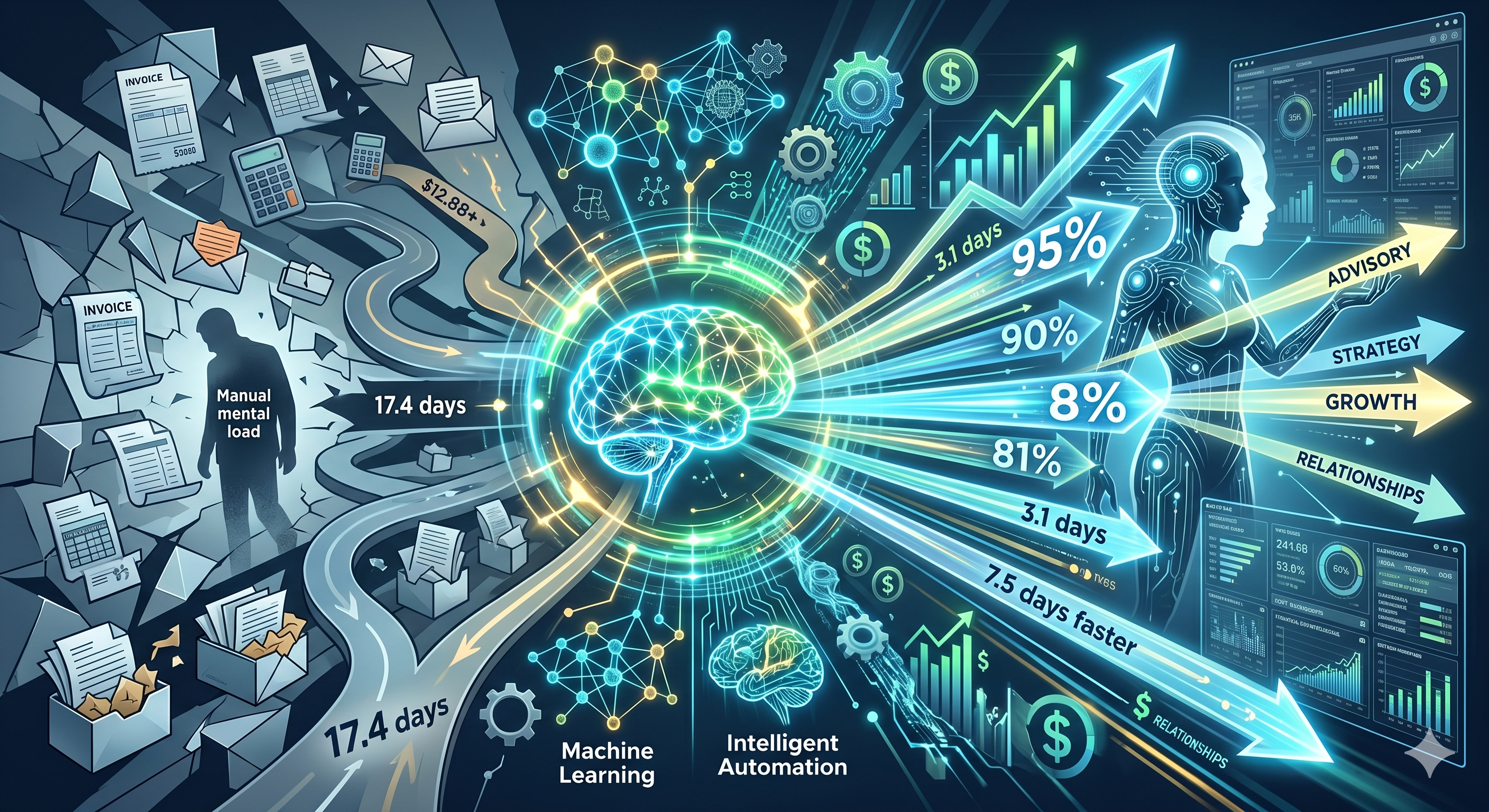
The Numbers Have Arrived — and They're Impossible to Ignore 95% of accounting firms now use automation in some form. 90% of firms use AI in some capacity as of late 2025. Accountants using generative AI close the month-end books 7.5 days faster and support 55% more clients per week. This isn't a trend on the horizon — it's the competitive reality on the ground right now. The question is no longer whether to adopt AI in accounting. It's how fast you can implement it before the gap between AI-enabled and manual firms becomes insurmountable. (Sources: Intuit QuickBooks Accountant Technology Survey 2025; MIT/Stanford Study, August 2025; Future Firm 2025) |
The State of AI Adoption in Accounting: 2025 Data
The shift from novelty to necessity in AI accounting has already happened. Multiple independent surveys and research studies published in 2025 paint a consistent picture: firms that have adopted AI automation are measurably outperforming those that haven't.
|
95% of accounting firms now use automation in some capacity Intuit QuickBooks, 2025 |
90% of firms use AI tools as of November 2025 Future Firm Survey, 2025 |
46% of accountants use AI every day — outpacing small businesses (28%) Intuit QuickBooks Accountant Survey, 2025 |
|
81% of accountants say AI directly improves their productivity QuickBooks ProAdvisor 2025 |
86% of accountants say AI reduces their mental load — a critical capacity unlock QuickBooks ProAdvisor 2025 |
93% of accountants leverage AI to strengthen their strategic advisory role for clients Intuit QuickBooks, 2025 |
These numbers come from a survey of 700 accounting professionals conducted by Intuit in 2025. But the most striking data comes from academic research. A joint study by MIT Sloan and Stanford Business School — published in August 2025 and analyzing hundreds of thousands of transactions across 79 small and mid-sized firms — quantified the AI accounting advantage with remarkable precision.
|
MIT & Stanford Study (August 2025): The Generative AI Advantage, Quantified Accountants using generative AI: closed month-end books 7.5 days faster; reallocated 8.5% of their time from data entry to high-value advisory work; supported 55% more clients per week compared to non-AI users; reported 21% higher billable hours; achieved 12% greater general ledger granularity (more detailed, informative financial reports). The researchers concluded: 'AI serves as a powerful assistant — enhancing productivity and accuracy — while the accountant's expertise ensures that the final outputs are sound.' (Source: Journal of Accountancy / CFO Dive, August 2025) |
Smarter Accounts Payable Management: From Manual to AI-Driven
Accounts payable has traditionally been one of the most labor-intensive functions in finance — and one of the most vulnerable to delays, errors, and fraud. AI transforms AP from a reactive processing function into a proactive financial control center.
|
$6.17B Global AP automation market size in 2025 Quadient, 2025 |
$11.17B Projected AP automation market size by 2030 Quadient, 2025 |
The AP automation market is growing at 14% CAGR, driven by compliance mandates, digital payment adoption, and the measurable ROI of faster, more accurate invoice processing. More than 80% of finance leaders say accelerating AP automation is a key part of their digital transformation plans for 2025 (Quadient).
The Invoice Processing Gap: Best-in-Class vs. Everyone Else
The performance gap between organizations using AI-powered AP and those using manual processes is strikingly wide. Here's what the benchmarks show for 2025:
Invoice Processing: Best-in-Class AI Teams vs. Average Organizations
|
Cost/invoice (manual) |
|
$12.88 |
||
|
Cost/invoice (AI best-in-class) |
|
$2.78 |
||
|
Days to process (manual avg.) |
|
17.4 days |
||
|
Days to process (AI best-in-class) |
|
3.1 days |
||
|
Touchless processing (manual avg.) |
|
~25% |
||
|
Touchless processing (AI leaders) |
|
52.8% |
Source: Quadient / Parseur AI Invoice Processing Benchmarks 2025. Best-in-class = top-quartile AP departments using AI automation.
AI-powered AP automation delivers measurable gains across every dimension: invoice exceptions drop by 40% (PLANERGY, 2025). OCR accuracy now reaches up to 98%. Leading AP teams achieve 52.8% touchless processing — nearly double the average rate. And for businesses processing high volumes, moving from $12.88 to $2.78 per invoice isn't just an efficiency metric; it's a material cost reduction.
What AI Does in Accounts Payable
Modern AI-powered AP systems handle the entire invoice lifecycle with minimal human intervention:
• Intelligent invoice capture:
• OCR + machine learning extract vendor names, amounts, due dates, line items, and tax codes automatically — with up to 99% accuracy from leading tools.
• Three-way matching:
• AI cross-checks invoices against purchase orders and delivery receipts, routing only genuine exceptions to human reviewers.
• Fraud and duplicate detection:
• ML models flag non-compliant invoices and suspicious patterns — a growing priority, with 29% of AP leaders citing fraud risk as a major challenge in 2025 (Quadient).
• Payment optimization:
• Predictive analytics identify early-payment discount opportunities and optimize payment timing for cash flow management.
• Compliance automation:
• AI automates tax code determination and e-invoicing compliance — critical as EU e-invoicing mandates (EN 16931) become mandatory and similar regulations accelerate across Latin America and India.
• 78% of CFOs
• view AI integration in AP as crucial (PYMNTS Research); 73% of mid-sized business executives believe AP automation boosts cash flow, savings, and growth.
Accounts Receivable Automation for Healthier Cash Flow
The AR side of the ledger is where cash flow health is made or broken. Late payments, manual follow-ups, and poor collections prioritization are chronic pain points for businesses of every size. AI transforms AR from a reactive chasing exercise into a data-driven collections system.
|
45–60 Average days AR aging with manual processes Articsledge / Industry Data, 2025 |
15–20 Average days AR aging with AI automation — a 50–65% improvement Articsledge, 2025 |
Forrester's 2025 AR Automation report identifies five AI use cases reshaping accounts receivable management across the industry:
|
AR Function |
How AI Transforms It |
|
Collection Management |
ML and predictive analytics assess at-risk payments, forecast overdue recovery, and tailor collection strategies by customer segment — improving prioritization and recovery rates. |
|
Cash Application |
AI analyzes historical invoice and payment patterns to automatically match incoming payments to open invoices, eliminating manual cash application bottlenecks. |
|
Payment Notice Management |
AI-driven text analytics categorize inbound AR communications; generative AI drafts reply templates and follow-up emails, saving significant time on routine correspondence. |
|
Deduction Management |
Predictive AI analyzes past behavior to identify unauthorized deductions; prescriptive analytics prioritize deductions by likelihood of being invalid, reducing revenue leakage. |
|
E-Invoice Delivery |
GenAI converts complex e-invoices into compliant formats for quick review by auditors and approvers, automating a process that previously required significant manual effort. |
Source: Forrester Research — Top AI Use Cases for Accounts Receivable Automation, 2025
Invoice Management Without Manual Bottlenecks
Invoice processing sits at the intersection of AP and AR — and it's historically the most error-prone element of accounting operations. According to industry data, manual invoice processing carries an error rate of 5–10% and costs between $12.88 and $19.83 per invoice depending on company size (Parseur, 2025).
|
AI Invoice Processing: The Performance Numbers Fully automated AP workflows process an average of 30 invoices per hour, compared to 5 invoices per hour manually — a 6x throughput improvement. Processing costs drop by up to 80% (from ~$12.88 to ~$2.78 per invoice at best-in-class). Manual error rates fall from 2% to 0.8% with AI. Invoice cycle times compress from 17.4 days (average manual) to 3.1 days (AI best-in-class). (Sources: Quadient 2025; Parseur AI Invoice Benchmarks 2025/2026) |
What makes modern AI invoice processing different from earlier OCR-based systems is the combination of machine learning, natural language processing, and intelligent exception handling. Rather than following rigid templates, AI tools learn vendor-specific document patterns, adapt to format variations, and improve accuracy over time. Invoices are processed consistently regardless of volume — eliminating the bottleneck that manual batch processing creates at month-end.
Bookkeeping Workflows That Scale with Your Firm
The scalability challenge is where manual bookkeeping processes fail most visibly. As transaction volumes grow — through business expansion, new clients, or higher-frequency operations — manual processes require proportional headcount growth. AI bookkeeping automation breaks this constraint entirely.
|
7 wks Additional capacity per employee per year unlocked by firms that invest in AI training Karbon State of AI in Accounting Report, 2025 |
71% More time saved daily by advanced AI users vs. beginners (79 min vs. 49 min/day) Karbon Report, 2025 |
Karbon's 2025 State of AI in Accounting Report — based on data from 500+ accounting professionals — found that firms investing in AI training unlock an additional seven weeks of productive capacity per employee per year. Advanced users (those who have fully integrated AI into their workflows) save 79 minutes per day compared to 49 minutes for beginners — a 71% efficiency advantage that compounds over time.
The Four Bookkeeping Tasks AI Handles Best
• Transaction categorization:
• AI learns classification patterns from historical data and applies them consistently to new transactions — eliminating the most time-intensive element of daily bookkeeping.
• Bank reconciliation:
• Continuous auto-reconciliation runs in the background, matching transactions to bank statements in real time rather than at month-end.
• Duplicate detection:
• ML models identify duplicate invoices and unusual entries before they enter the accounting system — protecting the integrity of financial records.
• Reporting and general ledger granularity:
• AI-enabled accountants achieve 12% greater general ledger granularity (MIT/Stanford Study) — more detailed, informative financial reporting delivered faster.
The Month-End Close: From 10 Days to 3 — The Data
Month-end close is the most resource-intensive recurring process in accounting. Manual close processes typically span 10–12 working days, involve significant manual reconciliation, and concentrate financial stress into a compressed period. AI automation fundamentally changes this timeline.
Month-End Close Timeline: Manual vs. AI-Assisted
|
Traditional manual close |
|
10–12 days |
||
|
AI-assisted close (average) |
|
3–5 days |
||
|
AI generative users (MIT/Stanford) |
|
7.5 days faster |
Sources: Industry benchmarks (Articsledge 2025); MIT/Stanford Study (Journal of Accountancy, August 2025)
The MIT/Stanford study is particularly significant because it uses controlled, real-world transaction data rather than vendor claims. Across 79 actual SME accounting clients, accountants using generative AI closed month-end books 7.5 days sooner. This is a material operational improvement — it accelerates financial reporting, reduces the stress of compressed deadlines, and frees finance teams for strategic work earlier each month.
Human Control Remains Central: What AI Does Not Replace
One of the most important findings across all 2025 AI accounting research is what AI does not change: the need for professional judgment, client relationships, and strategic financial expertise. The MIT/Stanford study was explicit: AI augments professional accounting expertise rather than replacing it.
|
AI Amplifies Human Judgment — It Doesn't Replace It Accountants set approval rules, define exception thresholds, and apply professional judgment to complex situations. AI applies those rules consistently at scale, flags anomalies that need human review, and handles the cognitive load of repetitive processing. The result: accountants spend 8.5% less time on data entry and 55% more time serving clients — not because they're doing less, but because they're doing more of what only humans can do. (Source: MIT/Stanford Study, August 2025) |
This dynamic is captured clearly in the advisory data. 93% of accountants now leverage AI to strengthen their strategic advisory role for clients (Intuit, 2025). AI-enabled accountants can give clients real-time information about cash flow, unpaid invoices, and payment trends — turning routine compliance work into high-value financial counsel. This shift from compliance processor to strategic advisor is where accounting firms find their most durable competitive advantage.
AI vs. Traditional Accounting: Complete Performance Comparison
This table consolidates benchmarked data from independent research organizations, academic studies, and industry surveys published in 2025 and early 2026. All figures are drawn from cited, third-party sources.
|
Metric |
Traditional / Manual |
AI-Automated |
Improvement |
|
Cost per invoice |
$12.88–$19.83 |
$2.36–$2.78 |
⬆ Up to 80% cost reduction |
|
Invoice cycle time |
17.4 days (avg.) |
3.1 days (best-in-class) |
⬆ 82% faster |
|
Touchless processing rate |
~25% (avg.) |
52.8% (leaders) |
⬆ 2x improvement |
|
Invoice exception rate |
22% (average orgs) |
9% (top performers) |
⬆ 59% fewer exceptions |
|
OCR accuracy rate |
~85% (traditional) |
Up to 98–99% |
⬆ Near-elimination of entry errors |
|
Month-end close |
10–12 working days |
3–5 days |
⬆ 60–70% faster |
|
Generative AI: close time |
Baseline |
7.5 days faster |
⬆ MIT/Stanford, Aug 2025 |
|
Accounts receivable aging |
45–60 days (avg.) |
15–20 days |
⬆ 50–65% faster collection |
|
Accounts payable fraud detection |
Sampling-based |
AI flags 100% of invoices |
⬆ Systematic vs. spot-check |
|
Accountant capacity |
Baseline |
+55% clients/week |
⬆ MIT/Stanford, Aug 2025 |
|
Billable hours |
Baseline |
+21% with gen AI |
⬆ MIT/Stanford, Aug 2025 |
|
Time on advisory work |
~20% |
~70% |
⬆ 3.5x shift to high-value work |
|
Processing costs (60-81% drop) |
100% (baseline) |
19–40% of original |
⬆ DualEntry/Auxis, 2026 |
|
AP automation AI adoption |
74% of depts plan to use |
48% already using |
⬆ Quadient, 2025 |
Sources: Quadient (2025); Parseur AI Benchmarks (2025/2026); MIT/Stanford Study (August 2025); Articsledge (2025); DualEntry/Auxis (2026); Intuit QuickBooks Accountant Survey (2025); Forrester Research (2025)
How AIdaptIQ Delivers End-to-End Accounting Automation
AIdaptIQ, developed by Number7AI, is built to deliver every dimension of the AI accounting advantage outlined in this document — within a single integrated platform that connects accounts payable, accounts receivable, invoice processing, and reconciliation into one AI-powered workflow.
|
1 |
Intelligent Invoice Capture & OCR Processing AIdaptIQ uses advanced OCR and AI recognition to extract complete invoice data — vendor details, amounts, dates, line items, taxes — with high accuracy, regardless of document format or template. Automatic conversion to structured, ERP-ready records. |
|
2 |
Automated AP Matching & Approval Routing AI cross-checks invoices against purchase orders and flags discrepancies. Predefined approval rules route exceptions to the right reviewers — minimizing human review to genuine edge cases only. |
|
3 |
AR Tracking & Collections Intelligence AIdaptIQ monitors sent invoices, matches incoming payments, and automatically highlights overdue accounts. Real-time aging data and payment trend analysis supports proactive cash flow management. |
|
4 |
Duplicate Detection & Anomaly Flagging ML models identify duplicate invoices and unusual transaction patterns before they enter accounting systems — protecting financial record integrity and reducing fraud exposure. |
|
5 |
Auto-Sync with QuickBooks, Xero & Sage Validated records synchronize directly with your existing accounting platform in real time. No manual data transfer, no reconciliation lag, no re-entry risk. |
|
6 |
Rule-Based Workflow Automation Accountants configure approval thresholds, exception rules, and workflow logic — maintaining full professional control while AI handles consistent execution at scale. Human judgment governs; AI applies it. |
Stronger Client Relationships Through Better Financial Visibility
The business case for AI accounting isn't purely internal. 93% of accountants use AI to strengthen their advisory role for clients (Intuit, 2025). When routine processing is automated, accountants shift from being reactive compliance processors to proactive financial partners — and clients notice.
|
55% More clients served per week by AI-using accountants vs. non-users MIT/Stanford Study, August 2025 |
84% of SMEs report being satisfied or very satisfied with AI-powered digital financial services Fiskl / CoinLaw Research, 2025 |
Real-time cash flow data, immediate payment status, and predictive collections insights transform what accountants can offer clients. Rather than monthly retrospective reports, AI-enabled accounting delivers continuous financial intelligence — enabling conversations about cash flow optimization, early payment discounts, and growth planning rather than just compliance status.
Tech-advanced accounting practices show up to 39% more revenue per employee than their non-AI counterparts (Rightworks, 2025). This isn't coincidental — it reflects the strategic premium clients place on advisors who provide timely, data-driven financial guidance.
Frequently Asked Questions: AI in Accounting
What is AI accounting software and what does it actually do?
AI accounting software uses machine learning, optical character recognition (OCR), natural language processing, and predictive analytics to automate bookkeeping, accounts payable, accounts receivable, and invoice management. Beyond automation, modern platforms like AIdaptIQ provide real-time financial visibility, predictive cash flow forecasting, and anomaly detection — capabilities that manual processes cannot replicate at any practical scale.
Will AI replace accountants?
The evidence consistently says no. The MIT/Stanford study found AI augments — not replaces — accounting expertise. Accountants using AI handle 55% more clients per week and spend more time on strategic advisory work. 93% of accountants use AI specifically to strengthen their role as client advisors. The transformation is from compliance processor to strategic partner, not from employed to replaced.
How much does AI accounting automation actually save?
Invoice processing costs fall by up to 80% (from ~$13 to ~$2.78 per invoice). Month-end close accelerates by 7.5 days. AP cycle times compress from 17.4 to 3.1 days at best-in-class. AR aging improves by 50–65%. Accountants using AI log 21% higher billable hours. For accounting firms, Karbon's research shows seven additional weeks of productive capacity per employee per year from AI adoption.
Is AI accounting automation suitable for small and mid-sized businesses?
SMEs are actually the fastest-growing AI accounting adopters. SME AI accounting adoption is growing at 44.6–45.2% CAGR (Mordor Intelligence, 2025). Cloud infrastructure, subscription pricing, and no-code platforms have eliminated the enterprise-only barriers that previously restricted AI deployment. AIdaptIQ is specifically designed for businesses that need enterprise-grade automation without enterprise-scale IT investment.
How does AI improve accounts payable compliance and fraud prevention?
AI applies consistent policy rules to every invoice rather than relying on periodic spot-checks. Duplicate detection, anomaly flagging, and e-invoicing compliance automation create a systematic fraud prevention layer that manual processes cannot match. With 29% of AP leaders citing fraud risk as a major 2025 challenge, and 74% of AP departments planning AI adoption, systematic AI-based controls are becoming the standard expectation, not the exception.
The Time for AI Accounting Is Now
The data is unambiguous. Firms using AI automation are processing invoices 6x faster, closing the books 7.5 days sooner, serving 55% more clients, and generating 21% more billable revenue. The gap between AI-enabled and manual accounting operations is widening — and it's widening fast.
AIdaptIQ delivers this advantage within a single platform: AP automation, AR tracking, invoice processing, duplicate detection, bookkeeping workflow management, and real-time integration with QuickBooks, Xero, and Sage. Rule-based workflows keep human expertise at the center while AI handles consistent execution at scale.
|
Ready to transform your accounting operations with AI? Start your free trial with AIdaptIQ — no credit card required. aiadaptiq.com | Developed by Number7AI |
Data Sources & References
• MIT Sloan / Stanford Business School — Generative AI in Accounting Study, August 2025 (277 accountants; 79 SME firms; 7.5-day faster close; 55% more clients; 21% higher billable hours; 12% GL granularity improvement)
• Intuit QuickBooks Accountant Technology Survey 2025 — 700 accounting professionals (95% automation adoption; 46% daily AI use; 81% productivity improvement; 86% mental load reduction; 93% advisory use)
• Quadient — 20 AP Automation Statistics 2025 ($6.17B market; 52.8% touchless processing; 3.1 days best-in-class; $2.78 cost/invoice; 40% exception reduction)
• PLANERGY — Accounts Payable in 2025 (AP automation market $1.47B; 14% CAGR; 40% drop in invoice exceptions; OCR 98% accuracy)
• Parseur — AI Invoice Processing Benchmarks 2025/2026 ($12.88–$19.83 manual cost/invoice; $2.78 AI best-in-class; 80% cost reduction; 30 vs. 5 invoices/hour)
• Forrester Research — Top AI Use Cases for AP Automation 2025; Top AI Use Cases for AR Automation 2025
• Karbon — State of AI in Accounting Report 2025 (500+ professionals; 7 additional weeks capacity/year; 71% more time saved for advanced users)
• Fiskl / CoinLaw / Global Growth Research — SME AI in Accounting 2025 (84% SME satisfaction; 50% cost reduction; 47% efficiency improvement)
• DualEntry — AI in Accounting 2026 Guide (processing costs drop 60–81%; error rates from 2% to 0.8%)
• Future Firm — AI in Accounting Complete Guide 2025 (90% of firms using AI; 3–4 hours per client freed per month)
• Rightworks — Tech-advanced practices show 39% more revenue per employee
• PYMNTS Research — 78% of CFOs view AP AI integration as crucial; 73% of executives believe it boosts cash flow and growth
• Journal of Accountancy / CFO Dive — Calculating AI's Impact on CPAs, August 2025